

 English
 Français
 Deutsch
 Nederlands
 Norsk
 Polski
 Español
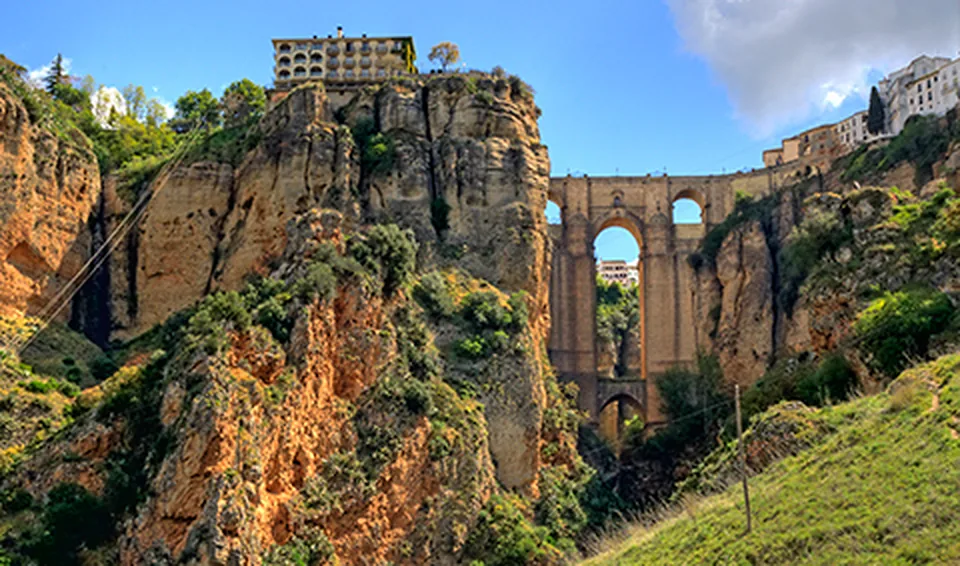
Ronda
About Ronda
Ronda is located in a hilly area about 750 meters above sea level.
The Guadalevín River carved the Tajo gorge, which divides Ronda in two. The city lies in the province of Málaga.
Ronda was first settled by the Celts, but its architecture reveals Roman and Moorish style.
Ronda has three bridges: San Miguel Bridge, the Old Bridge and New Bridge. The "New Bridge" may not be the most appropriate name since it was completed in 1793.
The New Bridge is the tallest of the three bridges and spans the Tajo gorge.
An important site is the Ronda bullring, the oldest bullring of Spain which is still used, albeit infrequently. It was built in 1784 in neoclassical style by the architect José Martin de Aldehuela, who also designed the New Bridge.
Another important site are the Arab Baths, which are partially intact, are below the city and date back to the thirteenth and fourteenth centuries.
Places to visit in Ronda
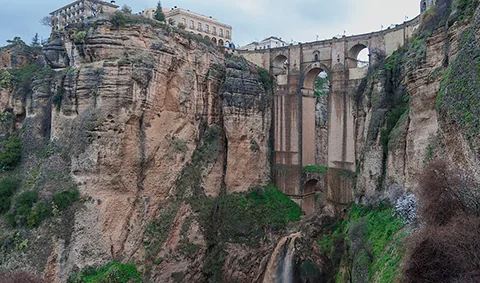
New Bridge
The Puente Nuevo was built between 1751 and 1793. It crosses the Tajo gorge and links Ronda's old town with the newer part of the city. A large central arch rises above the Guadalevín River, with two smaller arches near street level.
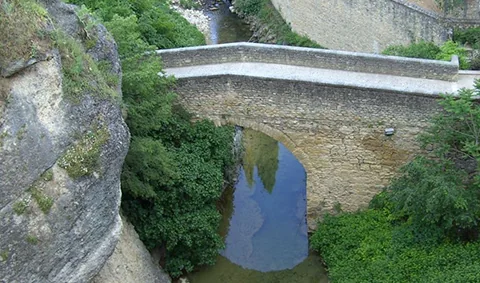
Saint Miguel Bridge
The origins of this bridge are not very clear, but it is said that probably has its beginning in the seventeenth century. The bridge is located on the Arch of Philip V. The arrangement of the bridge was paid by the company Tanners whose patron is San Miguel and whereby was named. It was used to access a natural water birth and move merchandise.
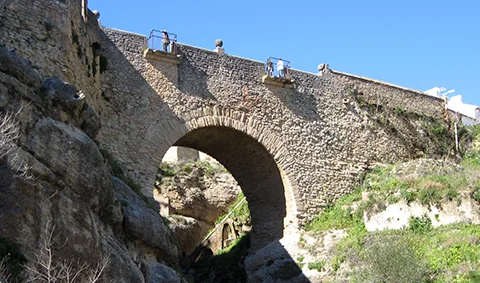
Old Bridge
It was the second bridge to be built in the city. By building the new bridge, he passed automatically called old bridge. It was built in the sixteenth century to unite the Islamic part of the old medina with the Barrio Padre de Jesus (neighborhood Father of Jesus). This bridge has a single arch threaded double brick. The balconies are the result of the remodeling the bridge but were not at seniority.
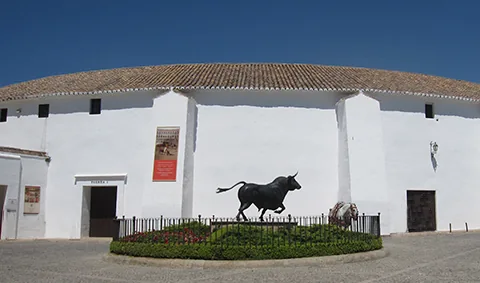
Bullring
Ronda is one of the cradles of modern bullfighting. Its bullring is the oldest that exist in Spain. The construction of this bullring lasted six years and was finally inaugurated in 1785 with a bullfight.
This bullring belongs to the Real Maestranza of Chivalry of Ronda. In this city the tradition of chivalry is preserved.
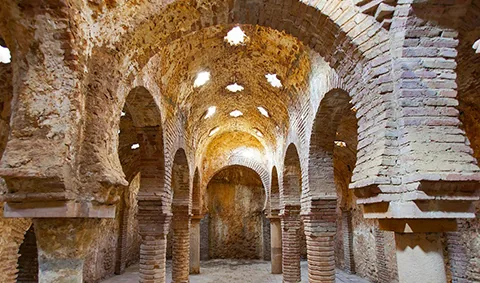
Arab baths
We found it in the ancient Islamic suburb of Ronda. They are the best preserved thermal baths of Spain belonging to the Muslim era. It is divided into three rooms perfectly preserved: the warm bath room, cold bath room and hot tub room.
It also preserves the boiler area, this area was used to heat water, but after the Christian conquest became tanneries.
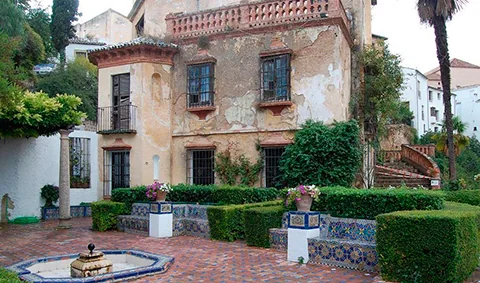
Moorish King’s house
The Casa del Rey Moro has an irregular layout on a steep slope and a façade with two towers of different heights. The visit takes in the terraced gardens, with their ponds, fountains and tiles, and the water mine, a stairway that descends into the Tajo gorge.